
Sintered NdFeB magnets are well known for being highly susceptible to oxidation and corrosion, which can eventually lead to a decline—or even a complete loss—of magnetic performance. For this reason, proper surface protection is essential before the magnets are put into use.
In one of our previous articles, Preventing Corrosion: The Essential Guide to Neodymium Magnet Coating/Plating, we introduced the major surface-finishing options for sintered NdFeB magnets. In addition to electroplating, NdFeB magnets can also be treated using electroless plating, electrophoretic coatings, and phosphating.
Today, we will take a closer look at phosphating, its purpose, and its advantages.
Purpose of Phosphating Treatment
Phosphating for sintered NdFeB magnets serves two main functions:
- Process-level Corrosion Protection
Because sintered NdFeB has a relatively porous and non-dense surface, bare magnets tend to oxidize when exposed to air. During storage, transportation, or when the final coating process is not yet determined, a temporary corrosion-protection measure is necessary. Phosphating provides an effective and practical solution.
Key advantages:
- Simple process with no need for specialized equipment
- Low material consumption (mainly acid, alkali, and phosphate solution)
- Very low production cost, suitable for process protection
- Helps prevent losses caused by long-term storage
- Produces a clean, uniform, and stable surface
- Compatible with vacuum packaging, greatly extending shelf life
- Superior to older storage methods such as oil coating or oil immersion
- A complete phosphate film can resist oxidation in normal atmospheric conditions
Additionally, phosphated magnets can easily proceed to the final coating stage. The phosphate film can be removed by a simple alkali wash, and it does not interfere with subsequent processes such as zinc plating, NiCuNi plating, epoxy coating, and more.
- Improved Surface Wettability
Some NdFeB magnets require bonding or coating with epoxy adhesives or epoxy paint. These materials adhere best when the base surface has strong wettability.
Phosphate films significantly improve the magnet’s surface wettability, which results in:
- stronger bonding strength with epoxy adhesives
- better coating performance with epoxy paints
- improved overall reliability of bonded assemblies
Good wettability ensures that the adhesive or paint forms a strong and uniform bond with the magnet surface.
Principles and Process of Phosphating
The phosphating process for NdFeB magnets generally follows this sequence:
Degreasing → Rinsing → Acid Pickling → Rinsing → Surface Conditioning → Phosphating → Sealing & Drying
- Degreasing and acid pickling are similar to the pre-treatment steps used before electroplating.
- Surface conditioning is a special pre-treatment designed to prepare the magnet surface for better phosphate film formation. NdFeB magnets are usually conditioned in a weak acidic solution, which adjusts the surface alloy composition and promotes the growth of a uniform phosphate layer.
Types of Phosphating Solutions
Modern phosphating is usually performed using commercial phosphating solutions. These solutions come in various systems:
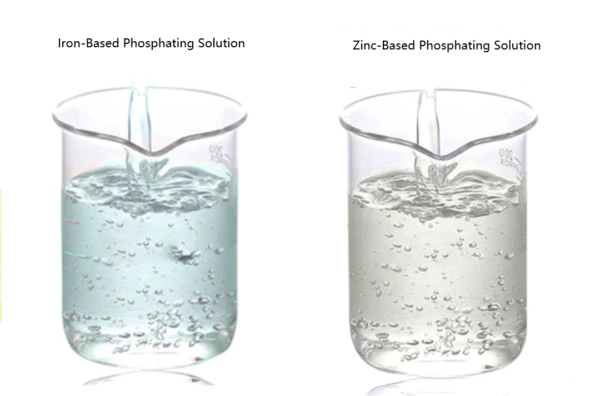
- Zinc-based
- Iron-based
- Manganese-based
- Binary, ternary, and multi-component formulations
Each system has its own strengths and limitations. Magnet manufacturers select different formulations based on:
- coating performance,
- compatibility with downstream processes,
- and cost considerations.
For NdFeB magnets that require zinc plating followed by phosphating, zinc-based phosphating solutions—or multi-component systems containing zinc—are preferred.
Temperature Classification of Phosphating
Phosphating processes can be categorized into:
- High-temperature phosphating
- Medium-temperature phosphating
- Room-temperature phosphating
Characteristics:
- High-temperature: produces a thicker, denser phosphate coating
- Room-temperature: typically results in a thinner coating
- Medium-temperature: provides performance between the two
Most magnet manufacturers use room-temperature phosphating, but even so, temperature must be carefully controlled—usually 15°C to 35°C—to maintain stability.
Why Do Phosphate-Coated Magnets Still Rust?
Some users report rust appearing even after phosphating. This can happen for several reasons:
- Insufficient phosphating solution concentration, resulting in a thin or porous coating that cannot block oxygen effectively.
- Incomplete rinsing, leaving acidic residues on the magnet surface; these acids can damage the phosphate film and lead to rusting.
Poor degreasing, which prevents uniform coating formation and compromises corrosion resistance.
How to Ensure Good Phosphating Quality
To achieve a stable and effective phosphate coating, manufacturers must:
- Maintain the correct composition of the phosphating solution
- Control the temperature within the proper range
- Keep the phosphating time between 10–15 minutes
- Use racks or reduce batch loading to ensure enough spacing between magnets for uniform treatment
Proper control of these factors greatly improves corrosion resistance and ensures consistent phosphating performance.
Summary
Phosphating is a simple, low-cost, and effective surface treatment for sintered NdFeB magnets. It provides temporary corrosion protection during storage and handling, and it also improves the surface wettability needed for strong epoxy bonding. By controlling solution composition, temperature, treatment time, and rinsing quality, manufacturers can achieve a clean, uniform phosphate layer that enhances both corrosion resistance and coating adhesion.