
Many customers ask EPI how much weight a magnet can lift. Online sources often claim that NdFeB magnets can lift objects weighing up to 600 times their own weight—but is this statement really accurate? Is there a calculation formula for magnet pull force?
In this article, we take a closer look at what people commonly refer to as a magnet’s “pulling power.”
In most magnet applications, magnetic flux or magnetic flux density is used to evaluate magnet performance—especially in motor designs. However, in certain applications such as magnetic separation, recovery, or lifting, flux alone does not accurately reflect real-world performance. In these cases, magnetic pull force is a much more relevant and practical indicator.
Magnetic pull force refers to the maximum weight of ferromagnetic material that a magnet can attract and hold. It is influenced by multiple factors, including the magnet’s magnetic properties, shape, size, and the distance between the magnet and the attracted object. Because of these variables, there is no universal mathematical formula that can precisely calculate a magnet’s pull force.
Instead, pull force is typically determined using specialized testing equipment, which measures the magnet’s pulling force and converts it into an equivalent lifting weight, as shown in the figure below. It is also important to note that pull force decreases rapidly as the distance between the magnet and the target object increases.
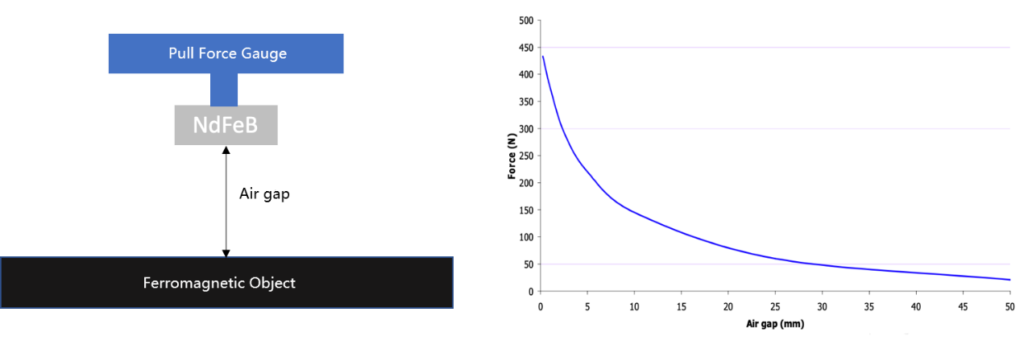
If you search online for magnet pull force calculations, you will often see statements such as:
“Based on experience, a neodymium magnet can lift objects weighing about 600 times its own weight”
(some sources even claim 640 times).
But how accurate is this so-called rule of thumb? The best way to answer that question is through experimental verification.
Experimental Setup
In this experiment, we selected sintered NdFeB N42 magnets with different shapes and dimensions. All samples were coated with Ni–Cu–Ni and magnetized through the thickness (axial magnetization).
For each magnet, we measured the maximum pull force at the north pole using a pull force gauge, and then converted the measured force into an equivalent lifting weight.
Key Findings
The test results clearly show that:
- The ratio between lifting capacity and the magnet’s own weight varies widely depending on magnet shape and size.
Some magnets lifted less than 200 times their own weight, others exceeded 500 times, and in some cases the ratio reached over 3,000 times.
This demonstrates that the commonly cited “600×” value is not universally valid. - For cylindrical or disc magnets with the same diameter, increasing the height significantly increases pull force. In practice, pull force is approximately proportional to magnet height.
- For cylindrical or disc magnets with the same height (blue-highlighted samples), increasing the diameter leads to higher pull force. In this case, pull force is approximately proportional to diameter.
- For magnets with the same volume and weight (gray-highlighted samples), differences in diameter and height still result in large variations in pull force.
In general, magnets with a longer dimension along the magnetization direction produce stronger pull force. - Magnets with the same pull force do not necessarily have the same shape, size, or weight. Conversely, magnets with the same volume or weight can exhibit very different pull forces depending on geometry.
- Regardless of shape, the length along the magnetization direction plays the most critical role in determining pull force.
The idea that a neodymium magnet can lift “600 times its own weight” is an oversimplification rather than a reliable rule. Experimental results clearly show that magnet pull force is not a fixed multiple of magnet weight. Instead, it is strongly influenced by magnet shape, dimensions, and especially the length along the magnetization direction, as well as the air gap between the magnet and the target.
In practice, two magnets with the same weight or volume can exhibit very different lifting capacities, while magnets with similar pull force may differ significantly in size and shape. Therefore, pull force should always be measured or specified under defined test conditions, rather than estimated using a single multiplier.