Origin of Magnetism in Permanent Magnets
The magnetic properties of permanent magnets primarily come from their crystal structure, which allows them to become strongly magnetized. Even after the external magnetic field is removed, the magnet retains its magnetism. Therefore, the magnetization process (also called charging or polarization) is a critical step for permanent magnetic materials such as NdFeB (Neodymium-Iron-Boron) to obtain and exhibit strong magnetism.
Isotropic vs. Anisotropic Magnets
Magnetic materials can be classified into isotropic and anisotropic magnets:
Type | Magnetic Characteristics | Notes |
Isotropic Magnets | Exhibit the same magnetic properties in all directions | Can be magnetized in any direction, easier to assemble and align |
Anisotropic Magnets | Magnetic properties vary depending on the direction | Have a preferred magnetic orientation, called the orientation (easy) axis, and deliver significantly higher magnetic performance |
During manufacturing, if a magnetic material undergoes a magnetic field orientation process, it becomes anisotropic.
Sintered NdFeB magnets are typically pressed and formed under a magnetic field, which aligns the powder particles along a specific direction. Therefore, the magnetization direction (future magnetizing direction) must be determined before production begins.
The magnetic field orientation of powder is one of the key technologies behind achieving high-performance NdFeB magnets.
Magnetization Direction
Magnetization refers to the process of applying an external magnetic field along the material’s orientation axis, gradually increasing the field strength until the magnet reaches technical saturation.
Sintered NdFeB magnets are commonly produced in various shapes, such as:
- Blocks
- Cylinders
- Rings
- Arc (tile) segments
Each of these magnet shapes typically has specific conventional magnetization directions, which we will explain in the following sections.

In addition to standard single-pole magnetization, sintered NdFeB ring magnets can also be magnetized into multi-pole configurations, where multiple N and S poles are formed on the same plane. This type of magnetization requires custom-designed fixtures and pole-piece heads, and therefore typically involves additional tooling costs.
Magnetization Methods
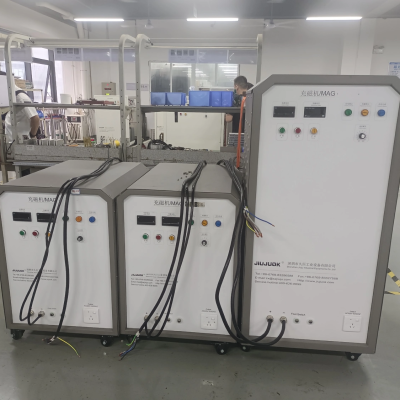
A magnetizing machine is used to apply a magnetic field to permanent magnetic materials or magnetic components. If the applied magnetic field does not reach the technical saturation level, the magnet will not achieve its intended remanence (Br) and coercivity (Hc) values. Therefore, determining the proper magnetizing energy is essential.
To determine the required magnetizing energy:
- Determine the magnet’s size and intended magnetization direction.
- Design and size the magnetizing fixture accordingly.
- Calculate the magnetic field strength at the fixture’s center.
The field strength should typically be 3 to 5 times the magnet’s coercivity. - Calculate the required magnetizing current.
- Based on the current and magnetizer voltage, determine the needed storage capacitor capacity.
- From this, the magnetizing machine’s energy level can be confirmed.
Basic Magnetization Principle
The fundamental principle of magnetization is to place the magnet inside a magnetic field generated by a current-carrying coil. Magnetization is generally performed in two ways:
- DC Magnetization
- Pulse Magnetization
Pulse magnetization is the most commonly used method for sintered NdFeB magnets, as it can rapidly generate a very high magnetic field intensity in a short time.