In our earlier article on Mitigating Eddy Current Losses in Rare-earth Permanent Magnets, we explained why eddy currents occur and how they can lead to heat generation and demagnetization in high-speed motors. Building on that foundation, this article introduces one of the most effective engineering solutions for reducing eddy current loss—magnet segmentation.
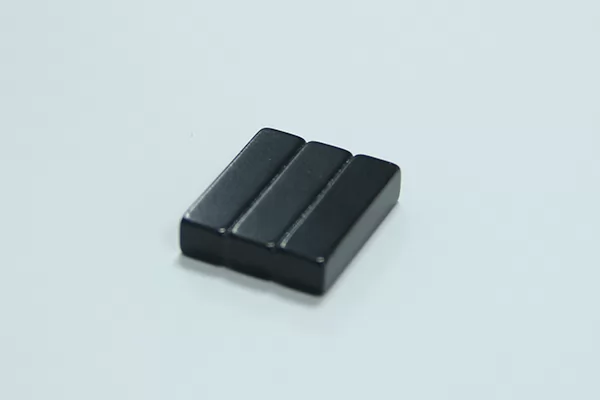
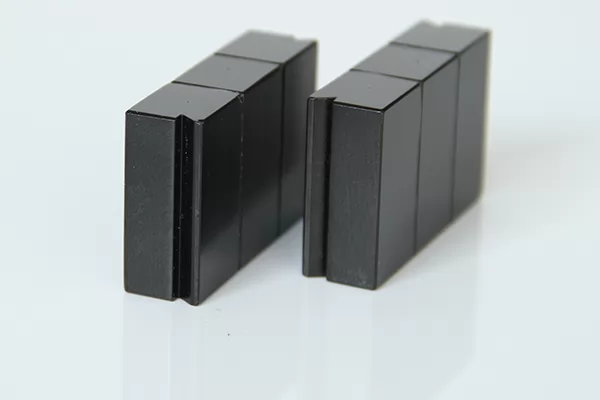
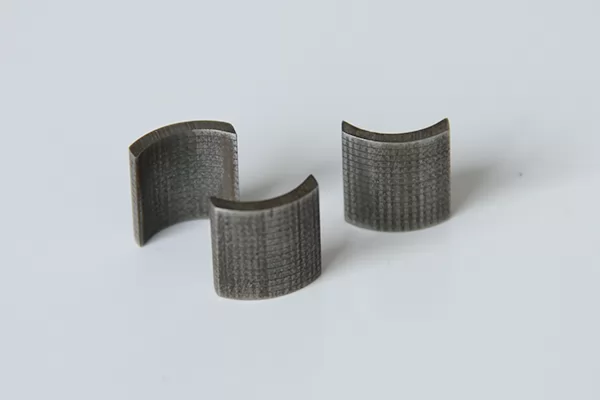
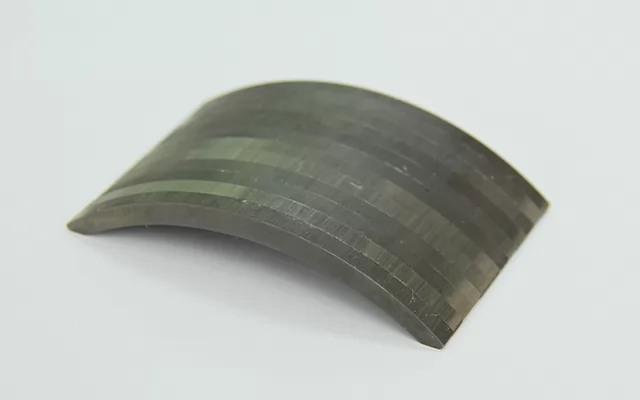
A magnet produced using segmentation technology is often referred to as a laminated magnet, segmented magnet, or sectioned magnet. The concept is straightforward: instead of using a single solid magnet, the magnet is divided into multiple smaller pieces, each piece is machined individually, and then the segments are bonded together with an insulating adhesive to form the required shape and dimensions.
How Can Eddy Current Loss in Rare-Earth Magnets Be Reduced?
There are several engineering and material-science approaches to lowering eddy current loss in rare-earth magnets. Among them, researchers have explored methods to increase the electrical resistivity of the magnet material itself, such as:
- Bonded Magnets
Because of the polymer binder used in bonded magnets, their electrical resistivity is typically 100 to 10,000 times higher than that of traditional sintered magnets. However, bonded magnets have limitations, including lower magnetic strength, reduced motor output capability, and lower maximum operating temperature.
- High-Resistivity Sintered Magnets
For sintered NdFeB magnets, sub-micron fluoride compounds can be added as modifiers to increase grain-boundary resistivity. These fluorides help form a high-resistivity layer along the grain boundaries, improving the overall resistivity of the magnet and reducing eddy current loss.

Magnet segmentation offers a highly practical way to increase the electrical resistivity of a magnet without altering its material composition. By dividing a magnet into smaller insulated sections, the eddy current pathways are disrupted, resulting in significantly lower eddy current loss.
In high-speed motors, power loss is one of the most critical concerns—especially eddy current loss, which is a major threat to rare-earth permanent magnets. Eddy currents generate heat inside the magnet, raising its temperature and potentially causing partial or irreversible demagnetization, which in turn reduces motor efficiency and reliability. Because rare-earth magnets are metallic and naturally exhibit low electrical resistivity, they are inherently susceptible to eddy current loss.
Below are more product photos: